

The Format Tax
Metadata isn’t the expensive part. Delivering it is — and 28 senior media operators just put a number on the difference.

In Amagi’s last Airtime Report, metadata kept surfacing as the quiet protagonist. Asked where AI could unlock the most value across media operations, leaders put metadata generation and enrichment at the very top of the list. In the same edition, consultant Brian Briskman put the dependency plainly: “If metadata isn’t consistent, everything downstream becomes a mess. Even the best AI tools can’t overcome that.”
So Amagi and FASTMaster went back to the industry with a narrower question: what is metadata actually costing you — and is anyone fixing it?
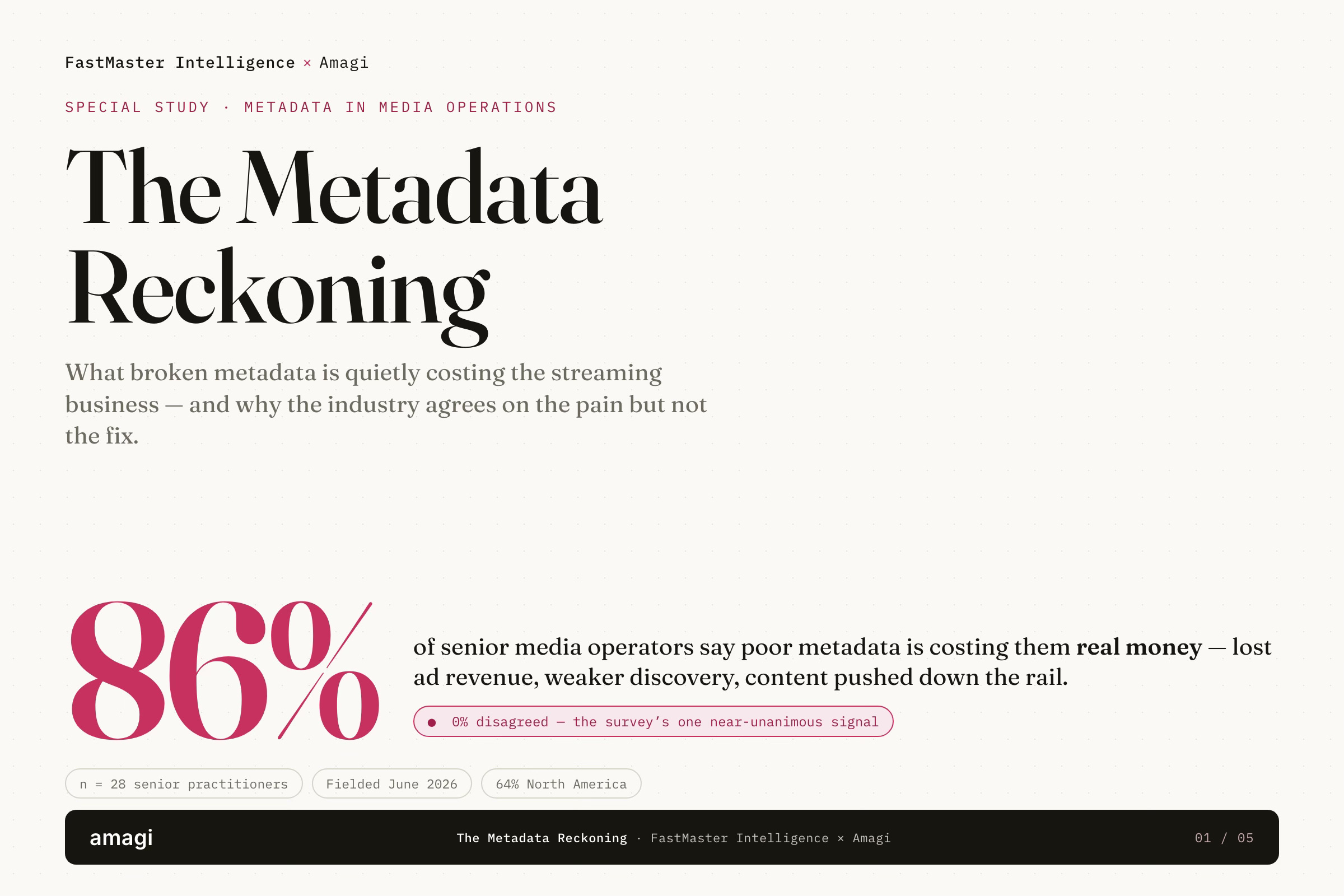
This piece is built on a focused pulse survey of 28 senior practitioners across the FAST and streaming value chain — content owners, channel operators, broadcasters, platforms, ad-side teams, and the technology vendors who serve them. More than a third sit in executive leadership; the rest run product, content operations, programming, and ad ops. It skews North American (64%), and at 28 responses it is a directional read, not a statistical verdict. But the signal is unusually consistent — and on two questions, nobody disagreed at all.
The picture that emerges is of an industry that has stopped treating metadata as a cost to minimise and started seeing the money it leaves on the table. 86% say poor metadata is actively costing them — lost ad revenue, weaker discovery, content buried down the rail — and not one respondent disagreed. That kind of consensus is rare.
Where the pain actually is
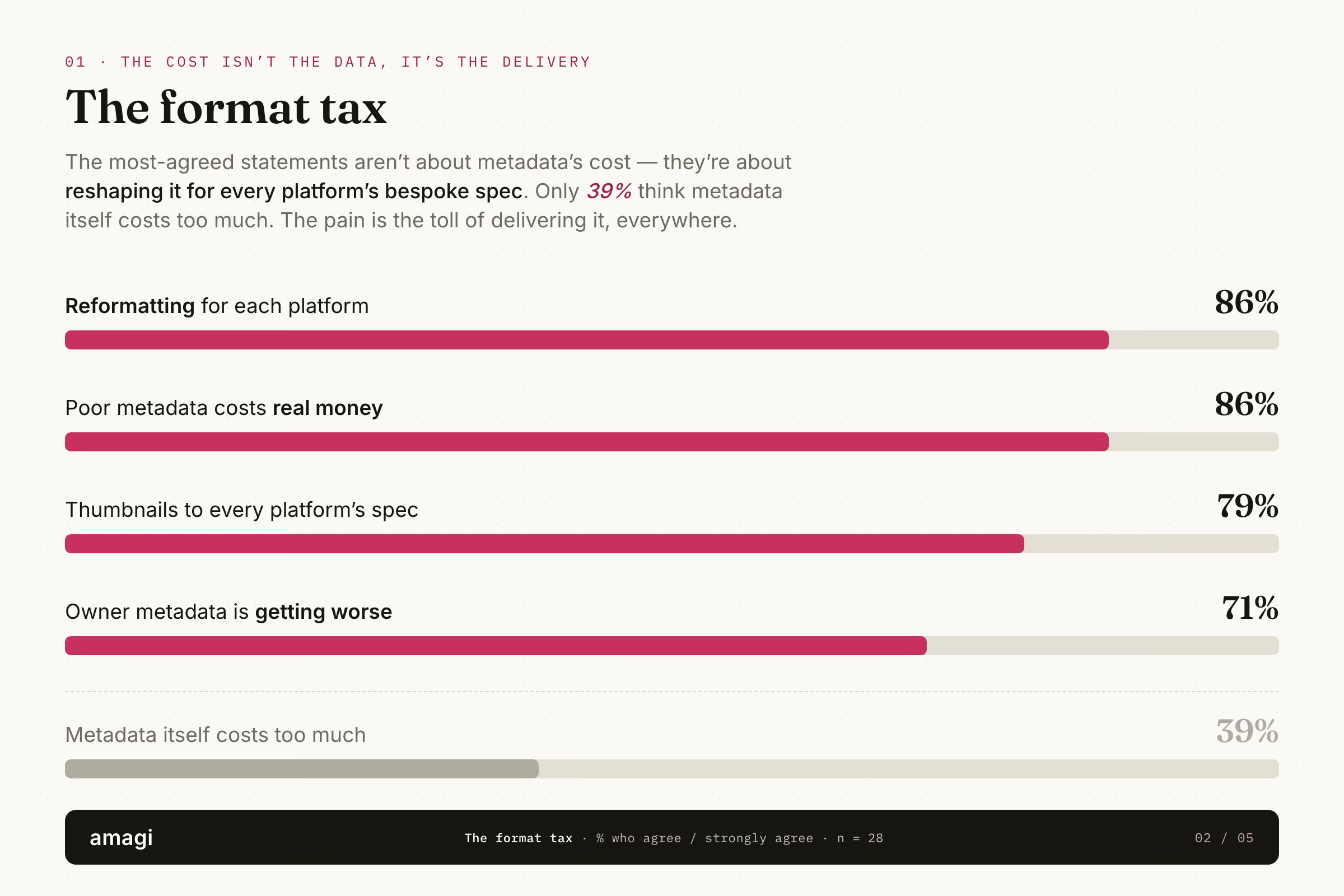
The frustration isn’t the metadata itself. It’s the toll of delivering it. Call it the format tax.
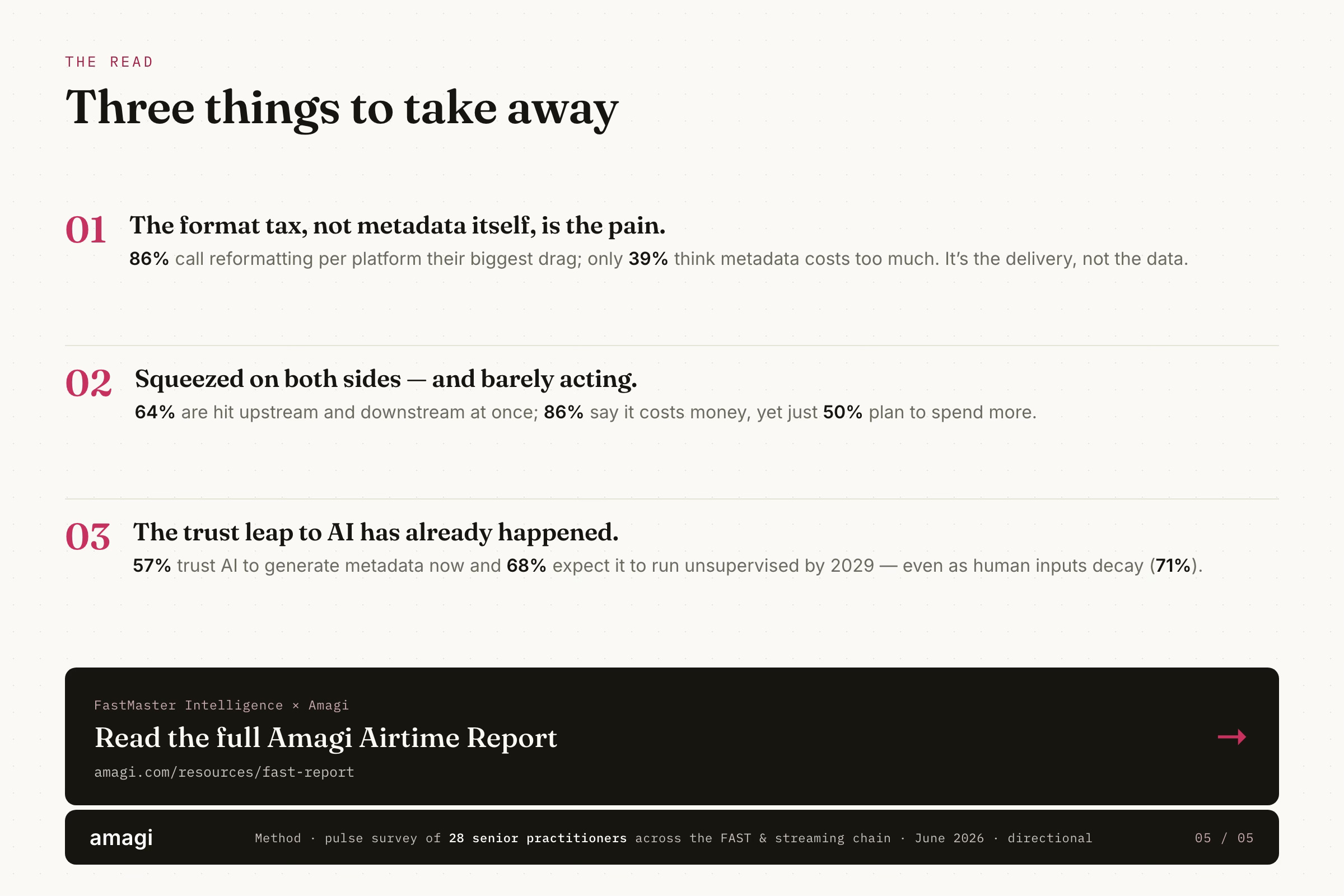
86% call reformatting for each platform’s bespoke requirements their single biggest operational drag — the most-agreed statement in the entire survey. 79% say producing thumbnails to every platform’s spec is among the most painful parts of distribution. But only 39% think metadata costs too much for the value it delivers. The problem isn’t creating metadata. It’s the toll of delivering it differently, everywhere.
Nearly every open-ended answer describes the same tax: “different templates for each platform,” “image formats, sizes, aspect ratios,” “all the variations needed across platforms.” One long sigh, twenty-eight times over.
The two-front squeeze
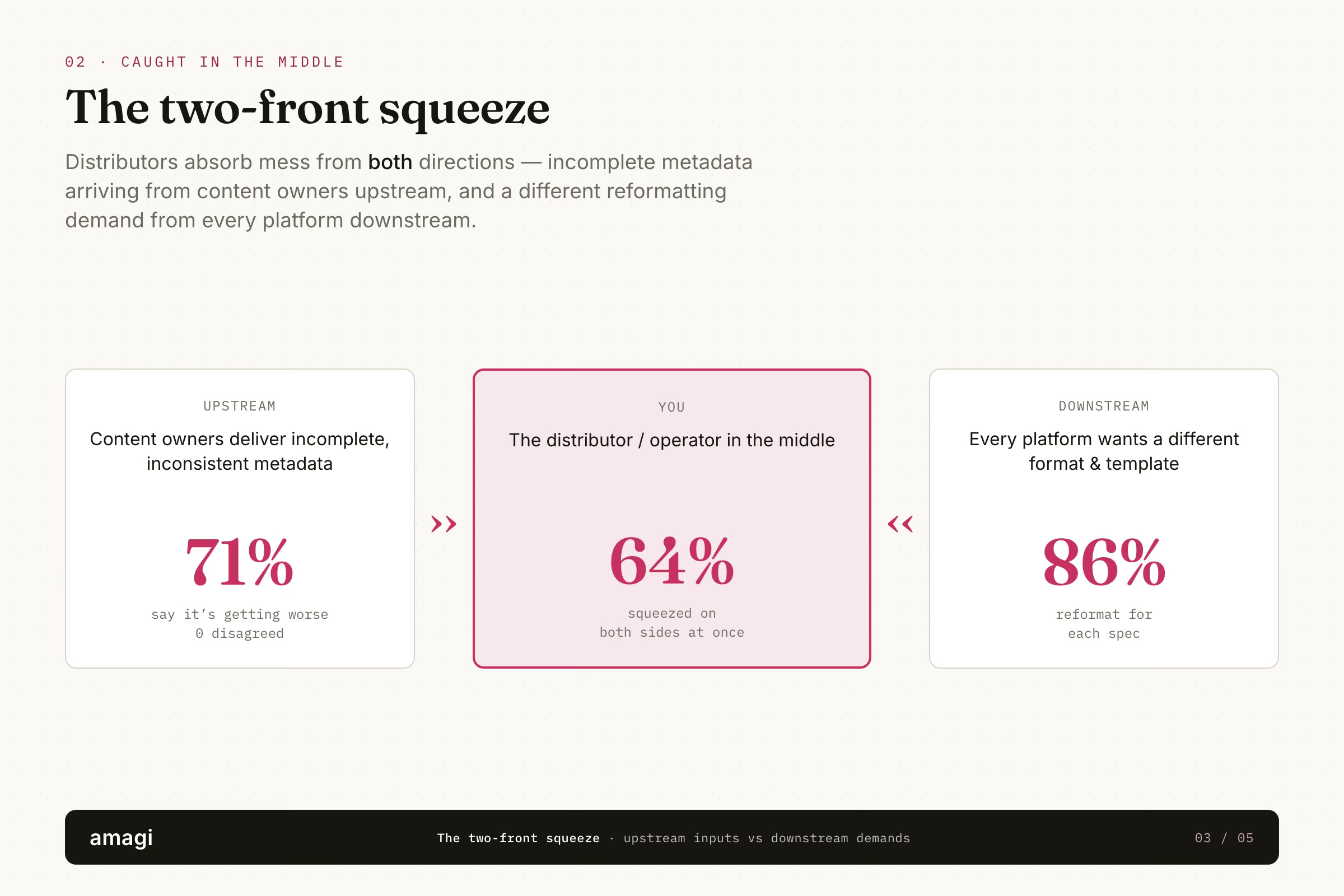
Underneath the format tax runs a squeeze from both directions. 71% say metadata from content owners arrives incomplete — missing genres, ratings, imagery, episode data — and that the problem is getting worse. Again, not a single respondent disagreed. At the same time, 86% are reshaping that same metadata for every downstream platform.
64% are hit on both sides at once. The channel operator and the aggregator sit between messy supply and fragmented demand, absorbing both. As one aggregator put it: “the lack of consistency in defining metadata fields — e.g. how content partners classify their content by genre.”
And it isn’t only completeness. Freshness and incumbent data quality draw fire too. One content owner’s verdict was blunt: “Not refreshed enough. And [a leading metadata provider] is poor.”
The action gap
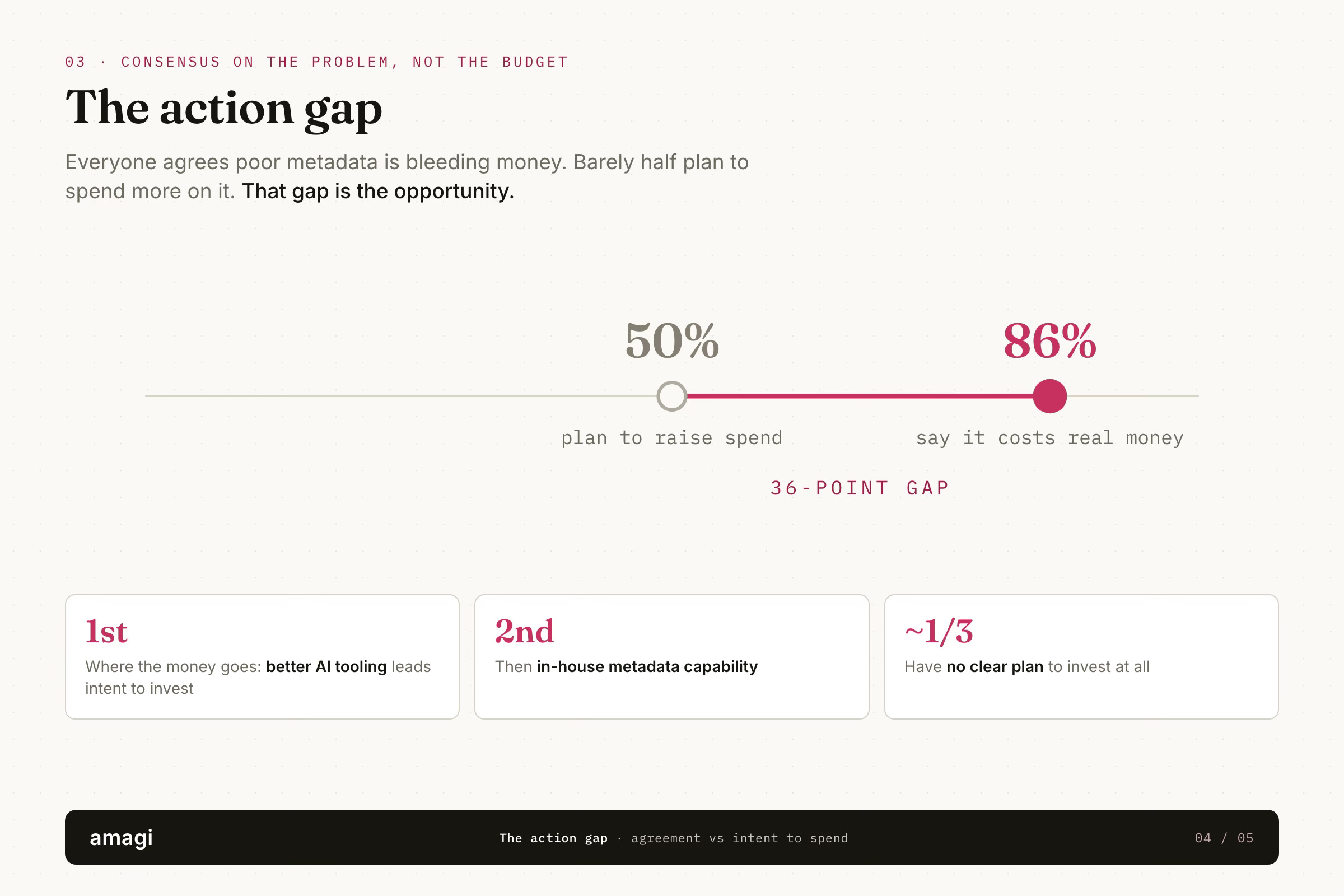
Here is the finding that should make somebody uncomfortable. 86% say poor metadata is costing them real money. Zero disagreed. Yet only half (50%) expect to meaningfully increase metadata spending over the next two years, and roughly a third have no clear investment plan at all.
Put the two together and the picture sharpens: of the 24 people who told us poor metadata is costing them money, only 11 committed to spending more on it. Thirteen acknowledged the leak and are not moving the budget.
The cost is acknowledged. The budget hasn’t caught up. That gap is the opportunity — and, for anyone selling into this problem, the entire commercial thesis.
The AI bet — and the irony
Then there is the bet on the machine. 57% say AI can already generate synopses, tags, and genres reliably enough that humans only need to spot-check it. 68% expect AI to handle most metadata generation with minimal human oversight within three years. “Better AI tooling” is the single most popular place to invest.
The irony writes itself. Practitioners trust the machine to write metadata faster than they trust their own partners to deliver it clean — and the partners are getting worse, not better. The industry would rather automate around the problem than fix its source.
The discovery floor is moving — so metadata matters more, not less
61% say good metadata still drives more connected-TV discovery than social, AI assistants, or personalised feeds do today. But 68% expect exactly those channels to overtake EPGs and metadata within three years.
That is not metadata becoming obsolete. It is metadata becoming the fuel the recommendation and agent layer runs on. As one respondent put it, the metadata that wins is the kind “that can be consumed by agents — human and AI.” Bad metadata won’t just look wrong in a grid. It will be invisible to the systems doing the recommending.
Standard-setting power is sliding to the platforms
68% expect the major streaming platforms — not content owners — to dictate metadata standards within three years. The reformatting tax is the early symptom; the deeper shift is who writes the rules. For content owners, that is the strategic stakes in a sentence: get your metadata house in order now, or inherit someone else’s spec later.
What to take away
• Fix the supply, don’t just automate around it. AI cannot outrun garbage inputs.
• Treat format and delivery fragmentation as the cost centre it is. That is where 86% feel the drag — not in metadata creation.
• Reframe metadata as a monetisation asset, not a compliance chore. As one OTT/CTV executive argued: “metadata is still treated like back-end hygiene, when it should function as a front-end monetization asset — because monetization starts the moment a viewer considers what to watch.”
Read the full report
The complete study — methodology, global FAST viewing and ad-impression data, and the operational playbook — is in the Amagi Airtime Report. I also built an interactive version of these findings, which you can explore alongside this post.
Method
A pulse survey of 28 senior practitioners across the FAST and streaming value chain — content owners, channel operators, broadcasters, platforms, agencies and media-technology vendors — fielded June 2026. 64% North America. At n = 28 this is a directional read, not a statistical verdict. Two items (poor metadata costs money; content-owner inputs are getting worse) drew zero disagreement. Figures are computed directly from the survey responses. Quotes are verbatim, lightly cleaned and anonymised; one vendor name has been redacted.