

June's FAST Analysis: Prime Adds a Local News Limit
Prime Video's decision to only show 20 of 200+ local channels sees a radical change in visible channels

The headline number says the US FAST market lost 5.0% of its channels between March and June — 1,526 left standing in June, down from the count a quarter earlier. Read that line and you’d assume the bundle is contracting. It isn’t. Strip out one bookkeeping event — Amazon moving its local-station listings behind a per-market gate, so a market that once saw 200-plus now sees about 20, lopping ~218 local listings off the count in a single stroke — and the apples-to-apples figure flips to +2.8%. The dial grew. The shrinkage was a filing change, not a fundamental.
Which is precisely the problem with a channel count: it tells you what’s on, never what the movement means. That gap is what The FAST Directory was built to close — a free, fast, US-wide read on the whole FAST dial across eight services, channel by channel, that does the interpretation a raw list won’t.
A read, not a roster
The Directory reads the dial through six lenses. Market gives you the whole universe — all 1,526 channels in June, the 30 carried on all eight services, the 632 that live on exactly one. Service breaks each platform down by genre, sub-genre and owner, and counts what’s exclusive to it. Owner answers who’s actually supplying the dial — Paramount tops it at 180 channels, a reminder that “fragmented” and “concentrated” are the same picture seen from different ends. Genre, Age Skew and Vintage do the demographic and catalogue-age work the rest of this piece runs on.
Two features carry more weight than they sound. The first is an Advertiser-Attractiveness score, 1–10 per channel — the “who would actually pay to sit next to this” read, which is the only question an ad buyer is really asking. The second is the unglamorous one that makes the rest trustworthy: rename standardization. When the same channel is listed under two names across quarters, the Directory merges it, so a relabel doesn’t masquerade as a drop plus a new add. In a market where a one-time gating decision can fake a 5% contraction, the plumbing matters as much as the analysis.
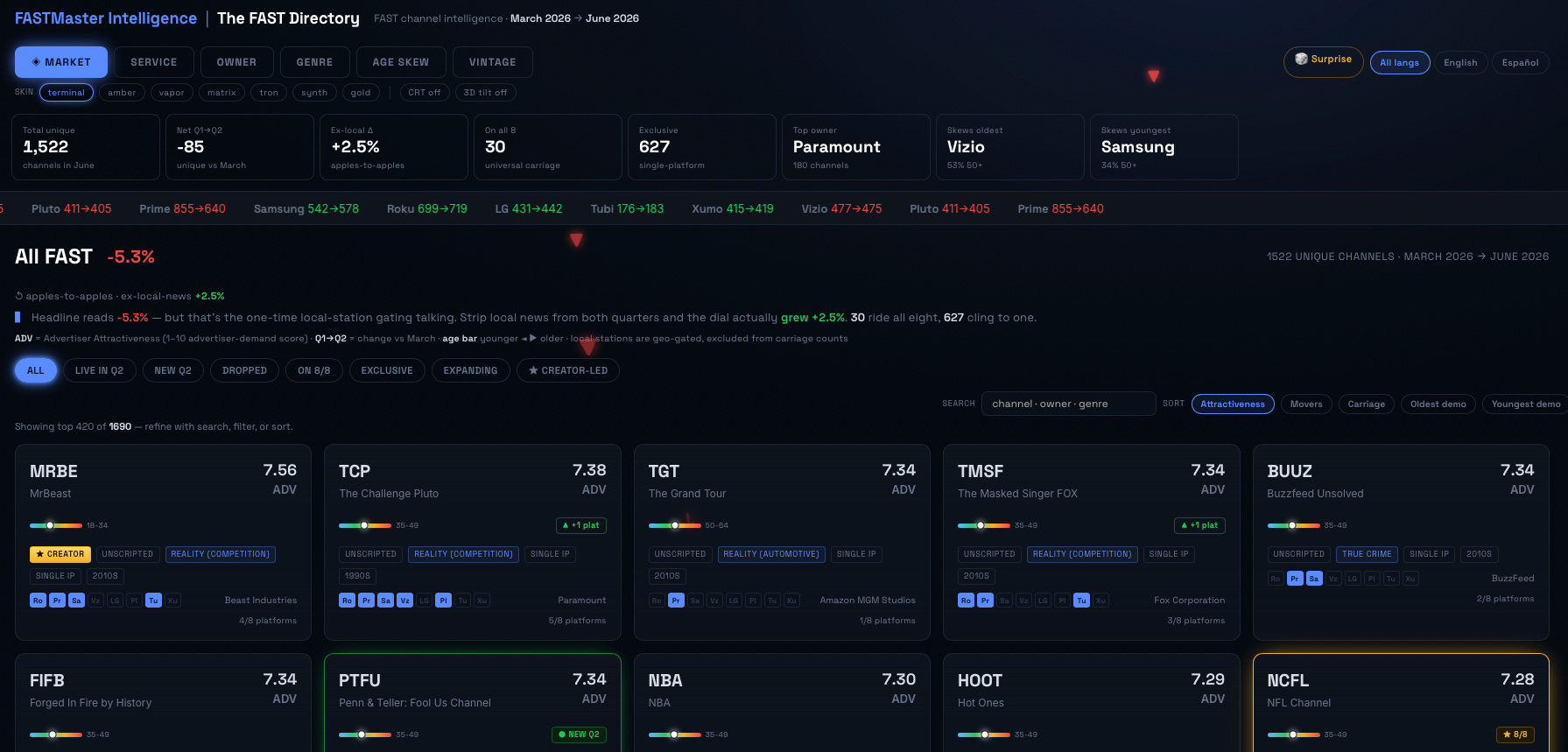
(a preview of the active site)
Three things worth the click
Prime’s collapse is a mirage. On the visible numbers, Prime Video went 855 → 645, a net -210 — easily the quarter’s ugliest line. Set the gated local stations aside and Prime’s non-local catalogue actually moved +8. The platform didn’t purge; it reclassified. The quarter-over-quarter carriage map, which tags every channel as new, dropped, or gaining-and-losing platforms, is what separates a reclassification from a retreat. Take the headline at face value and you’d write Prime’s obituary. The catalogue is fine. The presentation changed.
Pluto is the rerun vault. If the whole sector leans on the 2010s, Pluto leans further back than anyone: 49% of its single-IP and franchise channels premiered before 2000, with a median premiere year of 2000 flat. That isn’t an insult — it’s a strategy you can now see and price. Pluto sells the familiar, and the Vintage lens lets a buyer find the audience that wants exactly that.
The young dial and the old one are pulling apart. Vizio aims 53% of its channels at the 50-plus viewer, the oldest skew on the board; Samsung aims just 34% there, the youngest. And the quarter moved them further apart: the 65-plus cohort contracted 30.8% while the 18-34 cohort grew 4.8%. In fairness, that 65-plus collapse isn’t a verdict on older viewers — it’s the dropped local-news listings, which skewed oldest, leaving the building. But the Age Skew lens lets you separate the two stories instead of guessing, and the second story is real: the dial is getting younger where it isn’t getting gated.
There’s a fourth worth a look. Spanish-language FAST now runs 182 channels and grew 5.8% quarter over quarter, led by TelevisaUnivision — its own expansion story, not a footnote to anyone else’s. An EN/ES toggle recomputes the entire Market view, so that growth stops being a rounding error and becomes a segment you can actually plan against.
That’s the point of all of it. A channel count tells you what’s on. The carriage map, the attractiveness score, the demo leaderboard and the vintage stack tell you what it’s worth and which way it’s going. One of those is a list. The other is a decision.
The dial didn’t shrink this quarter. It got younger, more Spanish, and more honest with anyone willing to read past the headline. Read past it free.
→ fastdirectory.fastmaster-intelligence.com
I would be remiss to not note that I shall be at StreamTV next week. Feels like the announcements for that are pretty much everyone is posting that they will be going. But I’ll be hosting two panels on FAST (yes, actual FAST) on Wednesday and Thursday, so swing by if you please. Might not catch me at the FloRida performance (unless there are surprise guests).
If you enjoyed this article, or the fact that the FASTMaster Database is now free for everyone, please take the Amagi x FASTMaster streaming metadata by clicking the button below.